

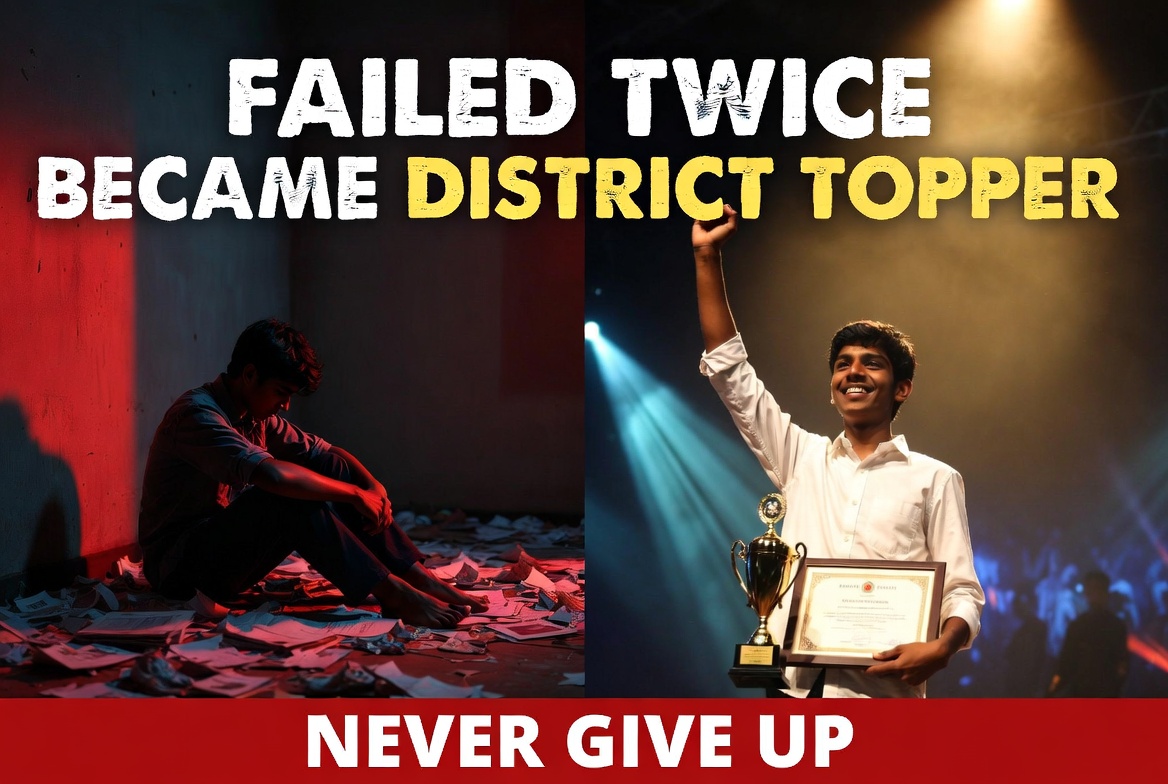
Rahul Kumar was 15 years old when the world labeled him a failure.
He had failed Class 9 not once, but twice. The second time, the result sheet was merciless: 38% in Mathematics, 41% in Science, and just 55% in English. His classmates moved to Class 10 while Rahul stayed behind, sitting in the same classroom with younger students who whispered behind his back.
His father, a small farmer, sat quietly on the charpoy that evening, looking at the result sheet under the dim light of a bulb. “Beta, maybe studying is not for you,” he said softly. His mother wiped her tears and added, “We can put you in vocational training. At least you’ll learn some skills.”
That night, Rahul cried himself to sleep. He felt like a burden on his family. The next morning, something inside him changed.
While cleaning his room, he found an old notebook from his first year in Class 9. In it, he had written in big letters: “I will become an engineer one day.” He stared at those words for a long time. Then he made a promise to himself: “I will not leave this school until I prove them wrong.”
A new Science teacher, Mr. Ahmed, had just joined the school. During the first week, he noticed Rahul sitting silently at the back. One day after class, he called him.
“Why do you look so sad, Rahul?” Rahul told him everything — the two failures, the taunts, and his family’s disappointment.
Mr. Ahmed listened patiently and then said, “Failure is not a person, it’s an event. The only mistake you made was studying the wrong way. From tomorrow, you will study with me after school.”
From that day, Rahul’s transformation began.
He started waking up at 5:00 AM. He studied for two hours before school using the Feynman Technique — explaining every topic in simple words as if teaching a small child. He used Active Recall instead of just reading. He made small flashcards and carried them everywhere. In the evening, he taught Mathematics and Science to Class 7 and 8 students in his neighborhood for free. Teaching others helped him understand the concepts deeply.
There were many difficult days. Sometimes he wanted to quit when he saw his old classmates enjoying new phones and cricket matches while he was studying. During the pre-board exams of Class 10, he scored only 61%. People laughed again. But this time, Rahul didn’t cry. He analyzed his mistakes and worked even harder.
He created a proper timetable:
- 5:00 AM – 7:00 AM: Mathematics & Physics
- After school: Chemistry & Biology
- Night: English & revision using Spaced Repetition
Six months later, the board exam results were announced.
When Rahul saw his marks, he couldn’t believe his eyes. He had scored 92.4% in Class 10. The same boy who had failed twice was now among the top 5 in the entire district.
But he didn’t stop there.
In Class 11 and 12, he continued the same discipline. He solved previous 10 years’ papers, took mock tests every Sunday, and kept teaching younger students. In 2026, when the Intermediate (Class 12) results came out, Rahul stood first in the entire district with 96.8% marks. He also cleared the engineering entrance test with a top rank and received a full scholarship at a prestigious engineering university.
At the district award ceremony, Rahul was invited to speak. His parents sat in the front row, tears flowing down their faces. Rahul looked at them and said:
“Two years ago, everyone told me to quit. My own parents lost hope. Today, I stand here not because I am more intelligent than others, but because I refused to give up. If a boy who failed twice can do this, then every student who is watching me right now can also achieve their dreams. Just believe in yourself when no one else does.”
Today, Rahul is in his first year of engineering. He still wakes up at 5 AM. He still teaches underprivileged students every weekend. And he still carries that old notebook with him — the one where he wrote his dream.
Moral of the Story: Your past failures do not define your future. What defines you is your willingness to learn from them and keep moving forward with discipline and faith.