

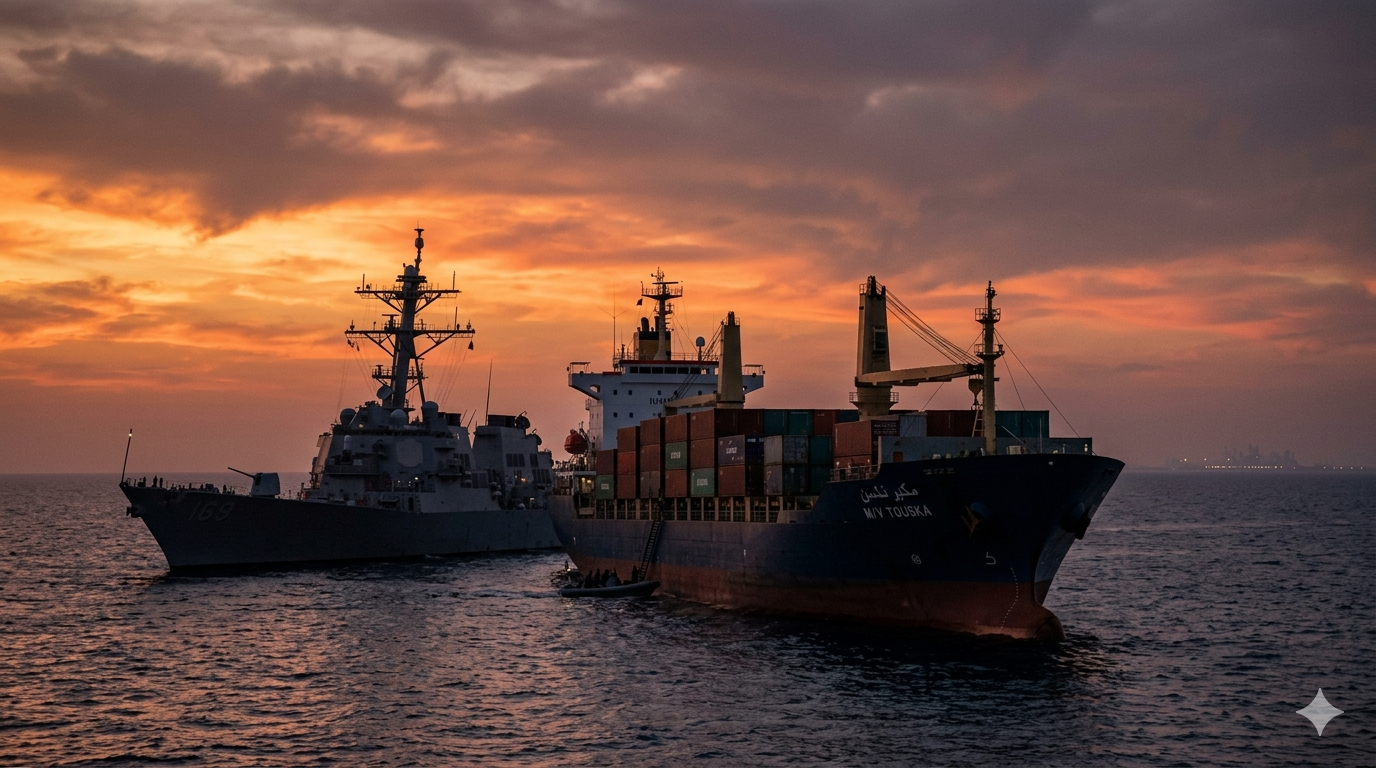
ISLAMABAD — In a move that underscores Pakistan’s increasingly delicate role as a regional “stabilizer,” the government in Islamabad today facilitated the high-stakes transfer of 22 Iranian crew members from the M/V Touska, an Iranian-flagged container ship seized by the U.S. Navy last month.
The seizure of the Touska off the coast of Chabahar has become the latest flashpoint in the escalating 2026 conflict between Washington and Tehran, raising urgent questions about the safety of commercial shipping in the North Arabian Sea and the economic survival of neighboring Pakistan.
The Incident: Piracy or Preemptive Security?
The Touska, operated by the sanctioned Islamic Republic of Iran Shipping Lines (IRISL), was intercepted by the USS Spruance in late April after allegedly violating a U.S.-led naval blockade. U.S. Central Command (CENTCOM) maintains the vessel failed to comply with warnings, while President Donald Trump—in a typically candid briefing—remarked that the U.S. Navy was acting “like pirates” to enforce the blockade.
Tehran has denounced the boarding as an “act of international piracy” and a violation of the fragile ceasefire brokered earlier this spring. The crew, now in Pakistani custody, are expected to be repatriated to Iran within 24 hours in what Islamabad calls a “confidence-building measure.”
Maritime Safety: A “Squeeze” on Pakistani Waters
For Pakistan, the Touska incident is more than a diplomatic headache; it is a direct threat to its maritime sovereignty and economic lifeline.
- Operation Muhafiz-ul-Bahr: In response to the conflict, the Pakistan Navy has launched a dedicated escort operation to protect merchant vessels. However, with U.S. warships conducting “Visit, Board, Search, and Seizure” (VBSS) operations so close to Pakistani territorial waters, the risk of a miscalculation or “accidental engagement” is at an all-time high.
- The Karachi Bottleneck: Over 3,100 shipping containers destined for Iran are currently stranded at Karachi Port. Insurance companies, wary of U.S. Treasury (OFAC) sanctions and the risk of seizure, have refused to provide coverage for any vessels suspected of Iranian links, effectively clogging Pakistan’s primary trade gateway.
Economic Fallout: The $800 Million Weekly Toll
The maritime conflict has hit the Pakistani public where it hurts most: the fuel pump.
“Pakistan’s weekly petroleum import bill has surged from $300 million to nearly $800 million,” Prime Minister Shehbaz Sharif noted in a recent address.
With Brent crude hovering above $112 per barrel and war-risk insurance premiums for the Strait of Hormuz skyrocketing by 3,600%, Pakistan is facing an annualized import liability that threatens to wipe out its entire export earnings for the year.